


Types of Bank Loans Explained: Personal, Home, Education, Business, and Eligibility
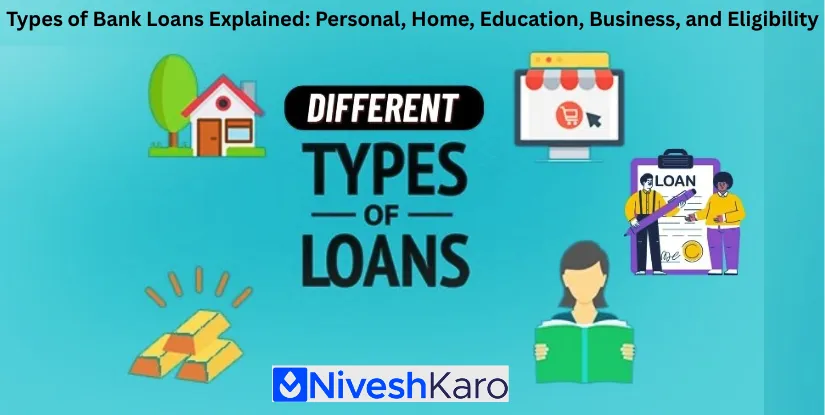
In the financial landscape of 2026, bank loans have evolved from mere debt instruments into strategic tools for wealth creation and personal growth. With the Unified Lending Interface (ULI) now fully operational across the Indian banking sector, the time taken to approve a loan has dropped from days to minutes. Whether you are a first-time homebuyer, a student aspiring for global education, or a startup founder looking for collateral-free credit, the rules of borrowing in 2026 are more transparent and tech-driven than ever before.
This guide provides a comprehensive breakdown of the various loan types available in 2026, their current interest rate ranges, and the stringent yet streamlined eligibility criteria mandated by the RBI and the Ministry of Finance.
1. Personal Loans: The Unsecured Liquidity Tool
Personal loans remain the most popular choice for immediate, flexible funding. In 2026, banks have shifted toward "Pre-Approved" models where your digital footprint (GST filings, salary credits, and utility bills) determines your limit in real-time via ULI.
- 2026 Interest Rates: For prime borrowers (CIBIL > 780), rates range from 10.5% to 12.5%. For other eligible categories, rates can go up to 15.5%.
- Purpose: From medical emergencies to wedding expenses and debt consolidation.
- Digital Speed: Most leading banks now offer "Instant Disbursal" where the loan amount hits your account in under 10 seconds of clicking "Accept" on your mobile app.
- Tenure: Flexible repayment options from 12 to 72 months.
2. Home Loans: Building Assets in a Stable Market
The real estate market in 2026 is supported by a stable interest rate environment. With the Repo Rate holding steady, home loan products have become more innovative, offering hybrid "Fixed-cum-Floating" options to protect buyers from future volatility.
Interest Rate Slabs 2026
- Floating Rates: Currently hovering between 8.4% and 9.5%, depending on the loan-to-value (LTV) ratio and the borrower's risk profile.
- Fixed Rates: Available at a slightly higher premium, typically starting from 10.5%.
RBI’s 2026 LTV Guidelines
To ensure market stability, the RBI maintains strict Loan-to-Value (LTV) ratios:
- Up to Rs. 30 Lakh: Up to 90% of the property value.
- Rs. 30 Lakh to Rs. 75 Lakh: Up to 80% of the property value.
- Above Rs. 75 Lakh: Maximum 75% of the property value.
3. Education Loans: Investing in Human Capital
2026 marks the widespread adoption of the PM-Vidyalaxmi Scheme, which has revolutionized how students fund higher education in India and abroad.
- Collateral-Free Limits: Under the 2026 guidelines, students getting into "Quality Higher Educational Institutions" (QHEIs) can avail of loans up to Rs. 7.5 Lakh without any collateral or third-party guarantee.
- Interest Subvention: For families with an annual income up to Rs. 8 Lakh, a 3% interest subvention is provided on loans up to Rs. 10 Lakh during the moratorium period.
- Moratorium Period: Repayment only starts 12 months after the completion of the course or 6 months after securing a job, whichever is earlier.
- Interest Rates: Typically linked to the bank's EBLR (External Benchmark Lending Rate) + a small spread, currently averaging 8.5% to 11%.
4. Gold Loans: High-Speed Secured Funding
With gold prices reaching new highs in 2026, the "Gold Loan" has become the smartest way to access cheap capital. Unlike personal loans, gold loans don't strictly depend on your income proof, making them ideal for the self-employed.
- 2026 Interest Rates: Extremely competitive, starting from 8.5% to 9.5% at major public sector banks.
- LTV Ratio: Banks can lend up to 75% of the gold's market value.
- Bullet Repayment: A popular 2026 feature where you only pay the interest every month and the entire principal at the end of the year, or even pay both at the end (as per the scheme).
- Tenure: Short-term cycles usually ranging from 3 to 24 months.
5. Business & MSME Loans: Fueling the $5 Trillion Dream
The government has significantly expanded the CGTMSE (Credit Guarantee Fund Trust for Micro and Small Enterprises) scheme to support the growing startup ecosystem.
- Collateral-Free Limit: Eligible MSMEs can now access up to Rs. 5 Crore in collateral-free credit. The government acts as the guarantor for the bank.
- Targeted Support: Women entrepreneurs and Agniveer-promoted MSEs receive up to 90% guarantee coverage, making it easier for banks to say "Yes."
- M&A Financing: For larger corporations (Net worth > Rs. 500 Cr), 2026 rules now allow banks to fund up to 75% of acquisition costs for corporate buyouts.
6. Eligibility Multipliers: The 55% Rule
In 2026, credit appraisal is no longer just about your salary; it's about your "Fixed Obligation to Income Ratio" (FOIR) or Debt-to-Income ratio.
- The 55% Threshold: For most retail loans (Home/Personal), your total monthly EMIs (existing + new) must not exceed 55% of your net monthly income.
- Multiplier Effect: Banks typically offer a home loan of approximately 60 to 72 times your monthly net salary, provided you have no other major liabilities.
- CIBIL Impact: A score below 700 in 2026 might not just result in a rejection but could lead to "Risk-based Pricing," where the bank charges you 1-2% higher interest than a prime borrower.
7. Loan Against Securities (LAS): Instant Liquidity via ULI
One of the most underutilized tools in the past, LAS has become a flagship digital product in 2026 thanks to the integration with the Account Aggregator framework.
- What is it? You pledge your Mutual Fund units or Demat shares as collateral while retaining ownership. You still get the dividends and price appreciation.
- LTV for Shares: Capped at 60% for listed shares.
- LTV for Mutual Funds: Up to 75% for Equity MFs and higher for Debt MFs.
- Overdraft Facility: Most investors use this as an "Overdraft" line. You only pay interest on the amount you actually withdraw, not the entire limit.
8. Car Loans: Financing the EV Shift
With the massive push for Electric Vehicles (EVs) in 2026, banks have introduced specialized "Green Car Loans."
- Green Discount: EV buyers often get a 0.25% to 0.50% discount on the standard car loan interest rate.
- Standard Rates: Currently range from 8.7% to 10.5% for new vehicles.
- Funding: Banks are increasingly offering 90% to 100% "On-Road Price" funding for top-tier salaried professionals, covering insurance and registration.
9. Loan Against Property (LAP): Maximizing Real Estate Value
LAP is a "Secured Business/Personal Loan" where you use your existing property as collateral. It is significantly cheaper than a personal loan.
- Interest Rates: Ranges from 9% to 12%.
- Long Tenure: Unlike personal loans, LAP can be repaid over 15 years, resulting in much smaller EMIs.
- No Usage Restriction: Unlike a home loan (which must buy a house), the money from LAP can be used for business expansion, children's weddings, or foreign travel.
10. The 2026 Digital Rights: Protection Against Mis-selling
The RBI has introduced strict "Responsible Lending" norms that apply for 2026 and onwards:
- KFS (Key Fact Statement): Every bank must provide a 1-page document clearly stating the Annual Percentage Rate (APR)—which includes interest plus all hidden fees and processing charges.
- Right to Switch: If a bank increases your floating rate, you have the right to switch to a fixed rate or transfer the loan to another bank without "unreasonable" penalties.
- Transparent Penalties: Penal charges for late payments must now be "Reasonable" and cannot be capitalized (you cannot be charged interest on the penalty amount).
Conclusion: Borrowing Smart in the New Era
The 2026 loan market is designed to reward the disciplined borrower. With ULI making documentation a thing of the past and CGTMSE removing the hurdle of collateral for small businesses, the barriers to capital have truly fallen. However, the "55% Debt-to-Income" rule remains the ultimate guardrail to prevent over-leveraging.
Check Your Loan Eligibility with NiveshKaro.com
Are you paying too much for your current loan? NiveshKaro.com’s "Refinance Calculator" scans 2026’s latest interest rates to see if you can save by switching to a new lender.
Related Articles:
- Loan Eligibility Calculator: How Much Loan Can You Get Based On Your Income And Credit
- Understanding Your CIBIL Score: Impact On Loan Approval And Ways To Improve Creditworthiness
- How To Reduce Home Loan Tenure From 25 To 5–10 Years– Save Lakhs With Smart Prepayment Strategies
- Essential Financial Glossary For Indian Investors: Understand Loans, Interest, Credit Scores, And More
- Role Of Reserve Bank Of India (RBI) In Banking Regulation And Monetary Policy
Read More: Manage loans effectively with insights from calculators, CIBIL improvement, home loan tips, glossaries, and RBI regulations in these connected reads.
AUTHOR


Subscribe To Our Newsletter
Subscribe to our newsletter to receive up to date news, ideas and resources to help to manage your investment and risks.